
Use case
AI for application review
Media application is careful, document-heavy work, and most of the time goes into looking things up. Background agents can do the legwork and hand the reviewer a dossier where every finding links to its source.
Here, I use a media application as an example, but the same approach could be applied to any other type of application
The problem
A media application team reviews each journalist application by hand. A standard form arrives, and each application needs the same checks:
- Is the media outlet real and legitimate?
- Do the documents agree with each other and with the form?
- Are the work samples genuine, and by this person?
- What does public-source research add?
The same document-consistency checks could also serve event management and visitor access workflows, where application volumes are far higher.
Targets from the proposal, not measured results.
Augmentation, not automation.
The system does research. It never decides. Findings are suggestions with sources, and the reviewer keeps full authority over every outcome.
- No automated application decisions
- No risk scoring or automatic rejection
- AI provides research assistance only
- The reviewer retains full authority
- Every finding is traceable to a public source
Five agents, one dossier
Each agent handles one kind of check and reports what it found, with evidence.
1. Submission Integrity
- Looks for
- Cross-field inconsistencies, such as a passport that expires before the assignment ends
- Junk values like “test”, “aaa”, “1234” or single-letter names
- Benefit
- Prevents wasted review time.
2. Organization Verification
- Inputs
- Outlet name, website, supervisor
- Checks
- Domain exists, and how old it is
- The media organization is active and legitimate
- Public masthead, and media type
- Benefit
- Skips the manual internet searching, with a clickable evidence report and links.
3. Identity Consistency
- Inputs
- Passport, press card, letter of assignment
- Checks
- Name normalization, such as Jean-François and Jean-Francois
- Date and nationality consistency
- OCR-extracted comparison
- Benefit
- Flags discrepancies. If accuracy is good, form fields could be pre-filled from the uploaded documents.
4. Publication Verification
- Inputs
- Work sample URLs and PDFs, letter of assignment
- Checks
- Link resolution: the link opens the story, not a 404
- Byline match: the article is by the applicant
- Outlet match: it comes from the real outlet, not a lookalike
- Topic alignment: the story fits the assignment
- Benefit
- Publishing history is verified instantly. No more spot-checking stale links.
5. Risk Agent
- Looks for
- Other relevant public information about the applicant and organization, such as sanctions lists or adverse public records.
- Output
- Neutral summaries. Every finding links to a specific, verifiable public source. No scoring.
- Benefit
- Reviewer are informed before review, never surprised during it. Full audit trail, no black boxes.
What the reviewer sees
Four screens in the concept. Illustrative mock screens with fictional data.
| ID | Applicant | Outlet | AI review |
|---|---|---|---|
| 1042 | A. Moreau | Northline News | AI Reviewed |
| 1043 | L. Chen | Harbor Daily | Partial |
| 1044 | P. Okafor | Meridian Wire | Processing |
| 1045 | M. Silva | Open Press | AI Reviewed |
| 1046 | S. Patel | Citywide Radio | Needs Review |
Outlet confirmed active. Supervisor appears on the public masthead. Classified as a major international news organization.
View source · View evidence · Mark incorrectAll article URLs resolve. Bylines match the applicant. Beat coverage matches the assignment.
View source · View evidence · Mark incorrectForm field “Jean-Francois” vs passport “Jean-François”: an encoding difference, not a discrepancy. No action required.
View source · View evidence · Mark incorrect16:15 · Reviewer A DECIDED
View full trace15:30 · AI service COMPLETED
View full trace15:24 · AI service MODULE
View full trace15:22 · AI service MODULE
View full traceProcessing · 2 of 5 complete
Queued · 0 of 5 complete
Queued · 0 of 5 complete
Technical review
Mostly deterministic checks, with small language models where meaning matters. A large language model is used only to turn structured findings into a readable summary.
Document intelligence
OCR (for example Tesseract), a structured extraction model and name normalization. Extracts passport and press card details, compares fields and detects encoding differences.
Web intelligence
Fetches website metadata and the masthead page, checks supervisor presence and domain age, and detects the outlet category with rule-based checks, HTML parsing, entity extraction and a small LLM.
Publication verification
Visits the article URL, extracts the byline and compares names, confirms the outlet and runs a basic semantic topic check, using entity matching and string similarity.
Contextual intelligence
The Risk Agent searches trusted public sources and summarizes neutrally, with retrieval-augmented generation, a strict evidence requirement and no scoring output.
Structured summarization
Converts structured findings into a readable dossier. This is where an LLM helps, constrained by structured input.
Background processing
An asynchronous queue with workers, so results arrive while the officer works. Reviewer can see partial results any time.
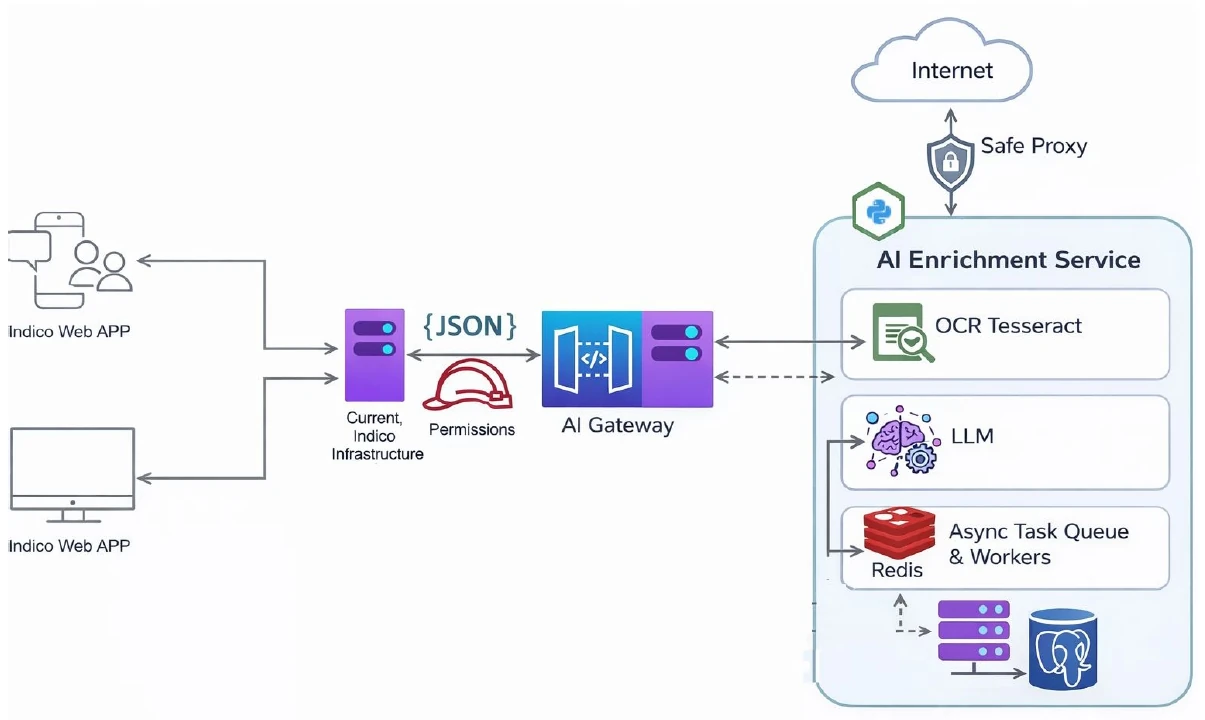
Design goals
- Zero data leakage: self-hosted LLM and OCR, and web access only through a safe proxy.
- A full evidence trail for every finding.
- About 5–8 seconds of background processing per application.
- Capacity target of 800–1,200 applications a day.
The risks and how they are handled are on the Trust page.
Run application or registration reviews?
I'd like to hear where your team spends its time, and what an assistant would have to prove before you'd rely on it.